Are There Any Art Schools With Division One Basketball Teams
On Nov. 28, an otherwise-insignificant men's college basketball game made national news when the UC Davis Aggies — a bona fide Division I team that made the NCAA Tournament every bit recently as 2017 — got diddled out past a for-profit art school in San Francisco.
It'south hard to know which was more than of a shock for viewers: that the Academy of Art University (whose jerseys read "Art U") vanquish the Aggies 79-sixty, that they've got the all-time record in the Sectionalization II Pacific West Conference — or that the school has a men'due south basketball game team at all.
But people involved with the program weren't surprised. That includes Art U's founding athletic director, former 49ers tight terminate Jamie Williams, who was instrumental in starting the school's sports section a niggling more than a decade ago.
"The first twelvemonth that we play someone actually skillful, we're going to become killed in every sport. But that's OK," he says of his earliest conversations about the athletics department. "Nosotros're going to larn from that."
Certain enough, since its first competitive games in 2008, Fine art U has managed to win national championships, produce Olympians and beat higher-ranked basketball teams — a remarkable cord of accomplishments for a still-developing program.
Academy of Fine art University itself has a much less savory reputation, though, as a scandal-decumbent, for-turn a profit schoolhouse that lets in anyone who applies. The university is owned by the Stephens family, who've made a killing ownership prime San Francisco real estate and leasing it back to the school. Running the testify is Elisa Stephens, 62, a staple of the San Francisco socialite scene with an $800 million fortune congenital largely from tuition.
In fact, the success of the sports program has been one of the few sources of positive headlines nearly the schoolhouse. And its creation can be traced back to a night in 2005, when Stephens — a sports fan looking to build upwardly the school's academic credentials — asked Williams to build an NCAA program from scratch.
'I want to beat somebody'
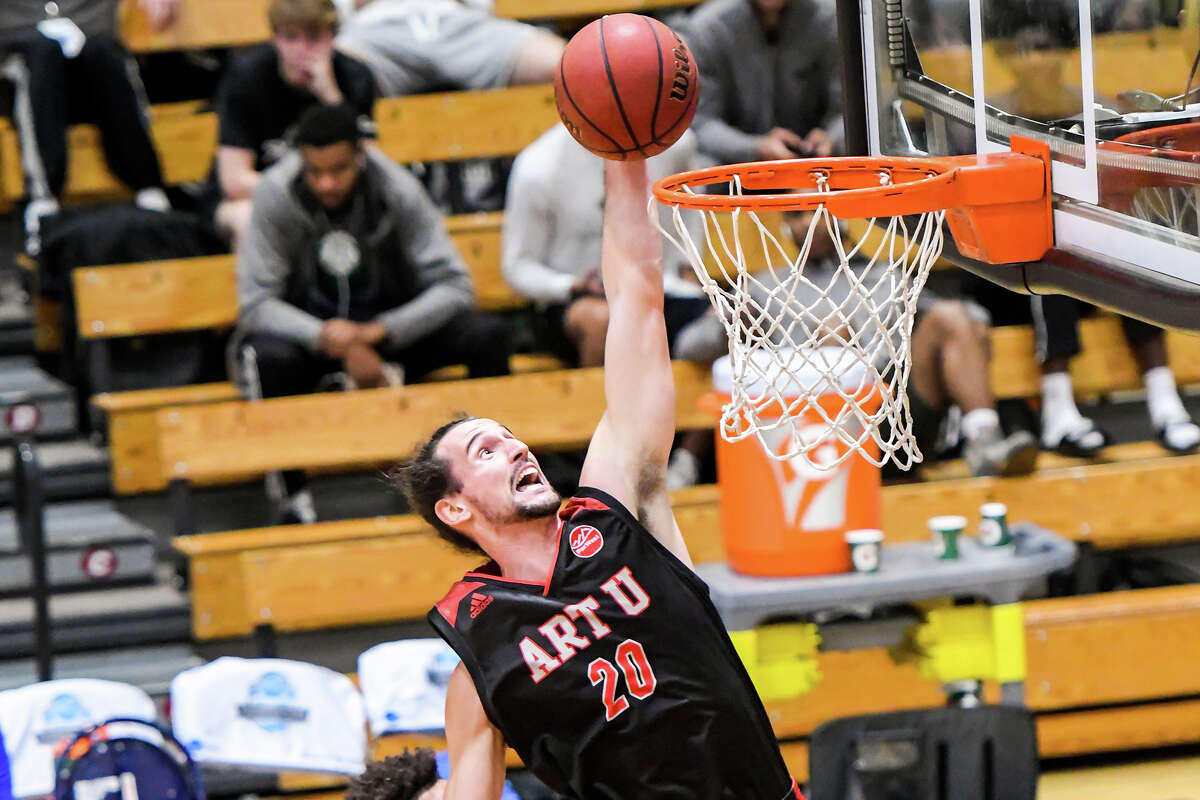
Academy of Art University guard Victor Ruiz de Carranza dunks the ball during the PacWest Men's Basketball game Championships, in 2020.
Photo by Darin Sicurello/Courtesy of the Academy of ArtWhen Stephens first reached out to Williams, he says he was skeptical about her adventurous idea: an art school with no sports teams edifice an athletics plan that could compete with the best teams in the region. But the idea was interesting enough that he agreed to encounter her at an Italian joint in North Embankment.
"I desire to be like Stanford or Cal athletics," he remembers her telling him over dinner. "I want to shell somebody."
The two made an odd couple: Stephens, who favors large brooches and brim-suits with linebacker-esque shoulder pads, was riding high, having sent profits at the school soaring with aggressive existent estate deals and, shall we say, generous offers to let anyone enroll. It's long had a dismal graduation charge per unit, one that hovers effectually 45%, according to the latest data — a discrepancy that tin charitably be described every bit a red flag. (Stephens didn't reply to SFGATE'south requests for comment.)
Williams, standing a burly 6-foot-4 with an amiable grin, had been out of the NFL since 1993 and was now unsuccessfully working on an contained picture venture. And then when Stephens asked for his advice, he gave it to her.
He started with logistics. Did the school have facilities? No, she said. Did it take any type of affiliation with an NCAA conference? No. Were in that location any coaches lined upwards? Non 1.
Those were but the obvious sticking points. Williams saw some more subtle challenges, besides.
"There are a couple of myths you're going to have to mitigate," he remembers telling Stephens. "No. ane, yous're a school full of artists. And in that location's a myth that you tin't exist an artist and be an athlete. No. ii: Because [the program] doesn't exist, there'southward going to be a lot of pushback from people not believing that you're committed and that you can practice it."
Co-ordinate to Williams — who is often the hero of the stories he tells — the last beat of the evening was directly out of an Aaron Sorkin show.
"I said, 'You lot're going to accept to get someone who's brave enough to start pushing that boulder upwardly the hill, who's not afraid, who knows what others don't know, and who's willing to build something that goes into perpetuity.'"
Stephens stared at him for a few seconds, he recalls. And then she asked: "Well, when tin y'all get-go?"
'We don't need you here'
Williams took the job in part because of his deep respect for Stephens, who he tells SFGATE "gets a bad rap in some circles" only is "awesome."
He as well knew he could plough her dream into something special. In fact, he didn't just predict the program's success — he may accept actually manifested it. "One of the best things with my own personal journey is being able to put a vision out at that place that's audacious enough that people would aspire to information technology," he says.
Only first, he had enormous institutional hurdles to overcome. Merely afterward he started, he says, the chair of the graphic design department poked her finger in his breast. "I don't desire whatever of your athletes in my department, considering they won't be able to handle information technology," he remembers her telling him. "We don't need you here."
Williams as well met with a larger grouping of faculty members, attempting to convince them that Stephens' investment in athletics wasn't going to be a waste of money. His method of persuasion was, as he explains, invoking Newton'due south first law of motion, a bold choice for a group of liberal arts-minded folks. (His charisma, information technology should be noted, is generally in the commitment; transcriptions of his words pale in comparing to hearing them.)
"You don't have athletics, you want to maintain the condition quo, yous desire to maintain inertia," he told the faculty members. "But when objects are in motion, they want to remain in move. If nosotros get this thing going, if y'all're behind what I'thou doing, it will do well and continue to do well. I'm going to do my role and I need you to exist there with me and give me a chance to create a proof of concept."
Earlier long, by his bookkeeping, he'd worked his magic and won them over. Even the graphic blueprint chair became a big supporter of the athletics section as his tenure connected, he says.
'The most difficult position I will ever have'
After getting the faculty on board, Williams had a whole staff to assemble and athletic scholarships to dole out. (Art U says it gives out the maximum amount allowed for Division Two programs.)
One early hire was the women'due south basketball game passenger vehicle, Lindsey Yamasaki, then in her belatedly 20s. She had played briefly in the WNBA and overseas earlier coming back to u.s.. When she got to San Francisco, she had to start more or less from scratch. "I remember the athletic department saying, 'OK, well, who'southward going to be your banana coach?'" Yamasaki says. "And I was like, 'Of what?'"
Yamasaki spent the summertime of 2008 recruiting an entire basketball game team. The students she managed to woo were a hodgepodge, including two college volleyball players, i in her mid-20s. Ii months later on the start of the schoolhouse year, the women's team played in its first game. Information technology was a disaster.
The inaugural men's basketball flavour wasn't any better. The beginning time they played a Division I opponent in November of 2008, they lost 74-23. Not even the schoolhouse'due south website could make information technology sound good. "The Urban Knights fought hard but were unable to detect the basket," read the declaration posted online.
Meghan Bushnell, who was initially Williams' assistant, remembers a clear-eyed and confident Williams in those early years, someone who never wavered in his belief that they could build a competitive athletics plan.
Rob Garcia, a basketball operations assistant at the time, remembers it differently.
"He was essentially trying to exist transparent with everyone by saying, 'Hey, this is kind of like a startup visitor. If this doesn't work out, for whatever reason, if people don't hear most it and we're not successful, we could close up tomorrow,"' says Garcia, now the school's sports information director.
It certainly had a scrappy vibe.
A student, shortly to be the school'due south offset baseball double-decker, made the teams' first logo. Colin Preston, initially hired every bit assistant able-bodied director, took on the task of assistant women's soccer coach, also — which meant driving the squad's school coach to practice. "It was definitely the virtually hard position that I will ever accept," says Preston — who ascended to athletic director in 2013, a position he held until 2016.
'Nobody likes to get crush past an artist'
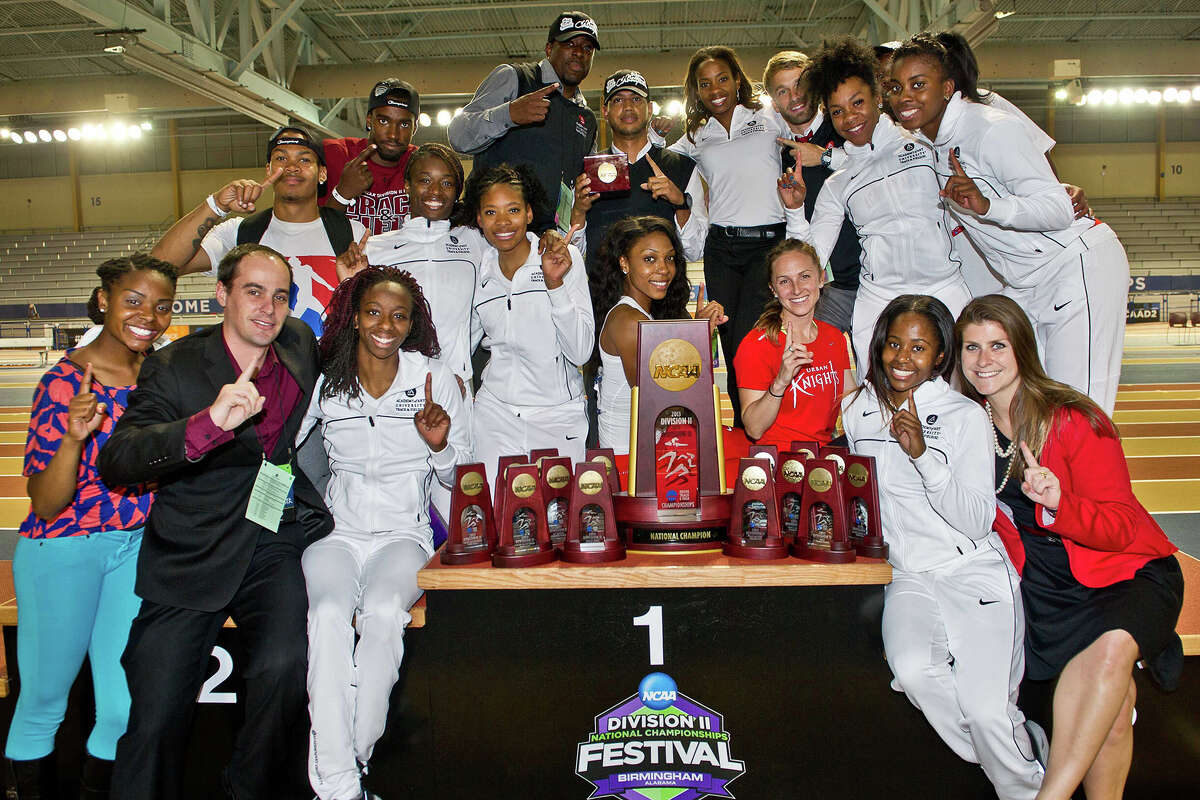
The Academy of Art Academy's 2013 indoor track & field team were Division Two NCAA Champions.
Photo by Padraic Major/Courtesy of the Academy of ArtIn July 2012, after a standard three-year probationary menses, Art U was formally greenlit every bit a Division Ii team in the Pacific West conference. (Stephens had told Williams to apply for NCAA Division I condition, simply there weren't whatsoever open slots — nor were in that location whatever slots in Division 3, seemingly a more advisable tier for the fledgling department.)
Attaining Division II status less than a decade subsequently Williams' dinner with Stephens was an undeniably impressive accomplishment, 1 that caught the Academy of Fine art'south peers past surprise.
"A lot of people didn't believe in what we were doing," says Bushnell, who worked her way up to associate athletics manager before leaving the university in 2015. "Jamie would always say nobody likes to get beat by an artist. It was and so true. Nosotros were these sleepers. No one took this seriously."
Williams, prone to colorful descriptors, went a pace further. "It'south a little fleck like state of war — you have people who are your cavalry, and people who are your archers, and so on," Williams says. "We were small. We were in an surroundings where startups were popping up like daisies in other industries. In that location was a lot of energy backside doing something that hadn't been done."
Which is not to say everyone has fond memories of those determinative years. Yamasaki, for instance, had many kind things to say about her three-twelvemonth coaching tenure. Only she left in 2011, partially over her growing reservations about the school itself, which was get-go to face real blowback for its unsavory practices.
"My antennae went up the more I learned about the school and how much real estate they had, and how much of a large, big business information technology was," she says. "I started to experience a little scrap more a little uneasy about what I was selling versus what the event was going to be for those students."
Ii scandals, in detail, stand out. In 2009, iv academic recruiters sued the school in federal court, alleging that it engaged in "illegal tactics to attract students and crook the federal government out of millions of dollars in financial aid," co-ordinate to the San Francisco Relate. (SFGATE and the San Francisco Relate are owned past the same parent company, Hearst, but operate independently of i another.) The recruiters declared they were promised huge — illegal — bonuses based on the number of students they were able to enroll. The case was finally settled for an undisclosed sum weeks before Fine art U beat UC Davis.
Then, in 2016, the city of San Francisco sued the school for ignoring "zoning codes, signage laws and celebrated preservation rules," while also "illegally [converting] affordable units into student housing," according to the San Francisco Relate. In 2020, Academy of Art University ceded and agreed to pay close to $60 1000000 in fines and fees.
'We look to win'
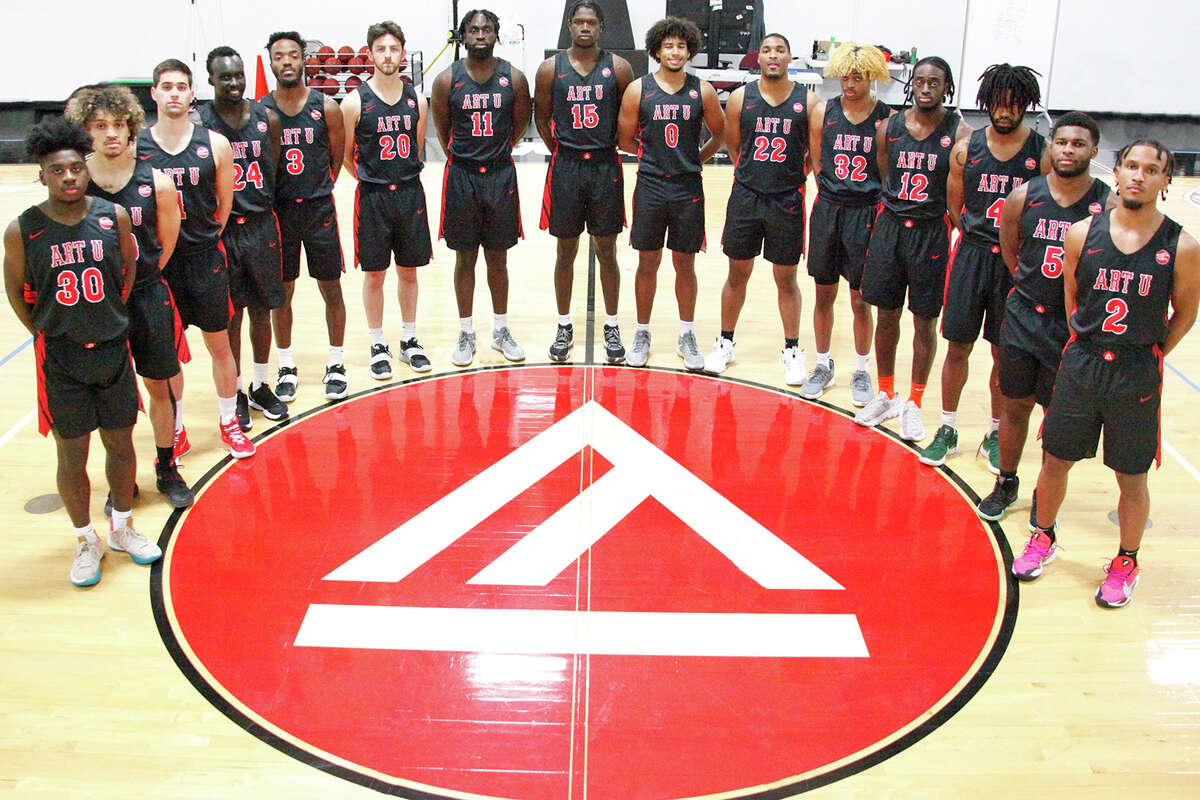
The 2021-2022 Academy of Art University men's basketball team is currently the just undefeated squad in the PacWest Briefing at iv-0. The squad recently won its sixth directly game.
Photograph by Rob Garcia/Courtesy of the Academy of Fine artAthletic department officials insist the school'due south scandals oasis't bled into their recruiting efforts. But they do acknowledge other obstacles faced by the teams.
Art U's basketball game and volleyball teams have their own practice courts in Southward San Francisco, for case, but the rest of the teams borrow space. The soccer squad practices and plays well-nigh of their games at a high school field in the Presidio. Baseball plays at Laney College in Oakland. Softball is at a field in Brisbane, south of Moo-cow Palace. Golf is all over the identify.
"That is our biggest challenge," admits Brad Jones, Art U's current athletics manager. Jones says he's working with Stephens to build out Art U's own facilities, something he'due south hoping will happen in the "near future."
Still, Fine art U has chalked up some truly surprising athletics successes. The women'southward indoor and outdoor track teams were crowned as national champions in 2013. Quondam sprinter Jordan Edwards, a photography major, became a three-time 400 meter national champion between 2014 and 2016. Communications major Bolade Ajomale, an University of Art alumnus representing Canada, won a bronze medal at the 2016 Olympics in the 4x100 meter competition. And, of course, at that place'southward the recent men's basketball game win confronting UC Davis.

University of Fine art University rails & field champions Mobolade Ajomale, left, and Vashti Thomas.
Photos by Rob Garcia & Padraic Major/Courtesy of the University of Art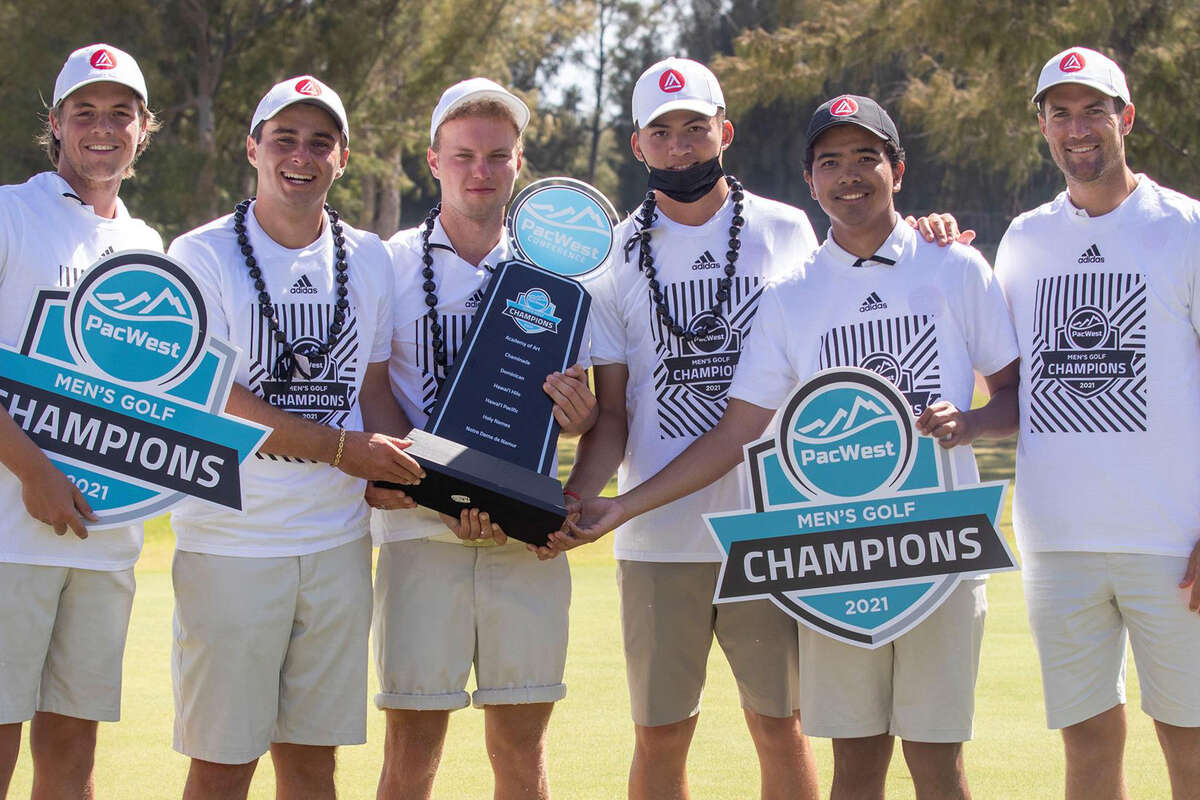
A grouping photo of the University of Fine art University's 2021 men's golf game squad after winning the PacWest title.
Photo by Aaron Fitzner/Courtesy of the Academy of Fine artPeople interviewed for this story disagreed most how involved Stephens still is in the teams she owns. "It was a shiny new toy for the academy at first," says i onetime athletics section employee, who requested anonymity in order to speak freely and was granted it in accordance with SFGATE'south ethics policy. "Then information technology became a chore to have meetings with us."
Others insist that Stephens — a large sports fan — is yet deeply interested in the program she created.
It would be unfair to discount Fine art U athletes — or even the department — over their clan with the schoolhouse. Universities of all stripes, not just for-profit ones, are extracting tens or hundreds of thousands of dollars from enrollees through dubious ways, equally the country's student loan crisis demonstrates.
Either way, it'due south impressive that, barely a decade after the chaos of those early days, Art U is winning titles and beating opponents a full league above them. The men'southward basketball team (eight-iii overall) is undefeated in Dec, owns the best record in its conference, and hasn't lost since information technology blew out UC Davis.
"We're truly proud of them," says current athletic director Jones. "Only I mean this very sincerely: We look to win." To that end, he says he was pleased to see the men's team'southward muted reaction after chirapsia UC Davis in a routine game, a sign of growing expectations.
"If you watch it, they didn't leap all over each other like they merely won the national championship," he says. "They high-fived, they got in line, they congratulated the other team, and went into the locker room and celebrated there. And that's the type of civilisation and type of program that we're trying to build."
Source: https://www.sfgate.com/collegesports/article/Academy-of-art-university-athletics-16717012.php

Posting Komentar untuk "Are There Any Art Schools With Division One Basketball Teams"