Looking Ahead Twenty Years in the United States, We Can Predict With Confidence That
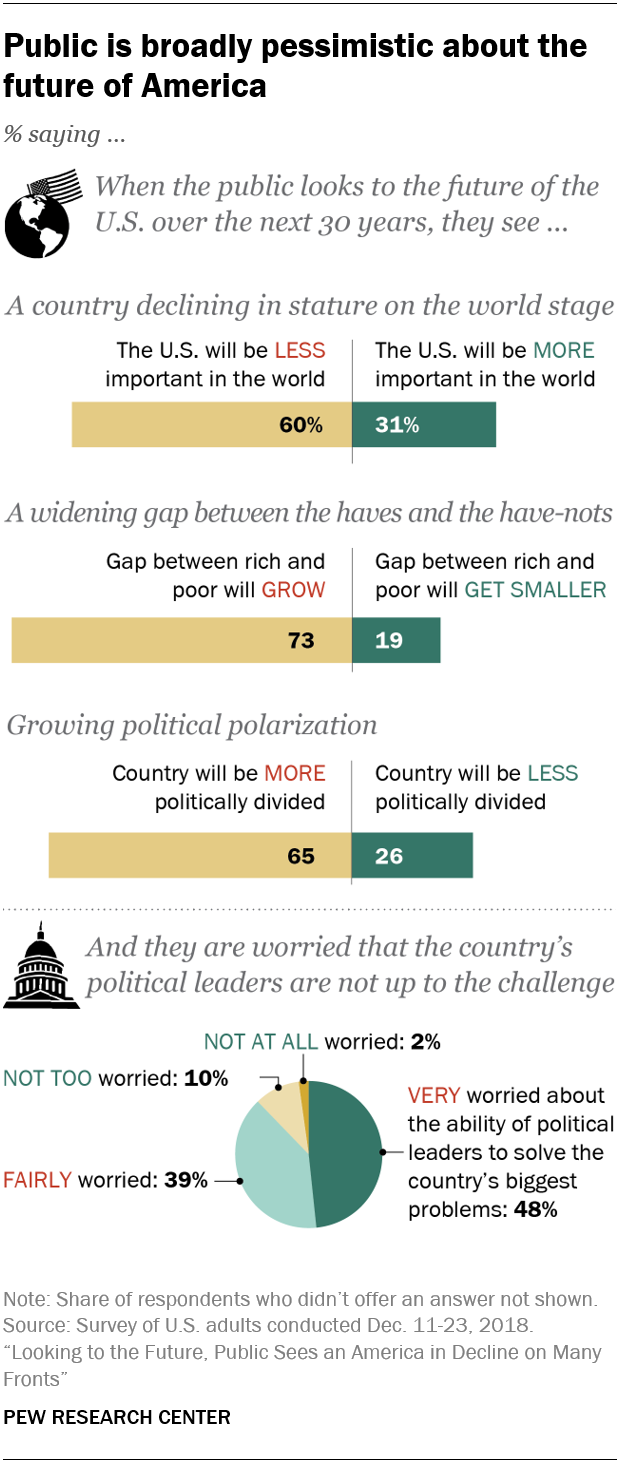 When Americans peer 30 years into the future, they run into a country in decline economically, politically and on the globe phase. While a narrow majority of the public (56%) say they are at to the lowest degree somewhat optimistic about America's futurity, hope gives way to uncertainty when the focus turns to specific issues.
A new Pew Research Centre survey focused on what Americans call back the The states will be like in 2050 finds that majorities of Americans foresee a land with a burgeoning national debt, a wider gap between the rich and the poor and a workforce threatened by automation.
Majorities predict that the economic system will be weaker, health intendance will exist less affordable, the status of the environment will exist worse and older Americans will take a harder fourth dimension making ends meet than they exercise now. Also predicted: a terrorist attack equally bad every bit or worse than nine/xi sometime over the next thirty years.
These grim predictions mirror, in part, the public'south sour mood about the current land of the country. The share of Americans who are dissatisfied with the way things are going in the land – seven-in-ten in January of 2022 – is higher at present than at any time in the past year.
The view of the U.S. in 2050 that the public sees in its crystal ball includes major changes in the land's political leadership. Most nine-in-ten predict that a woman will exist elected president, and roughly two-thirds (65%) say the same about a Hispanic person. And, on a decidedly optimistic notation, more than half await a cure for Alzheimer's disease by 2050.
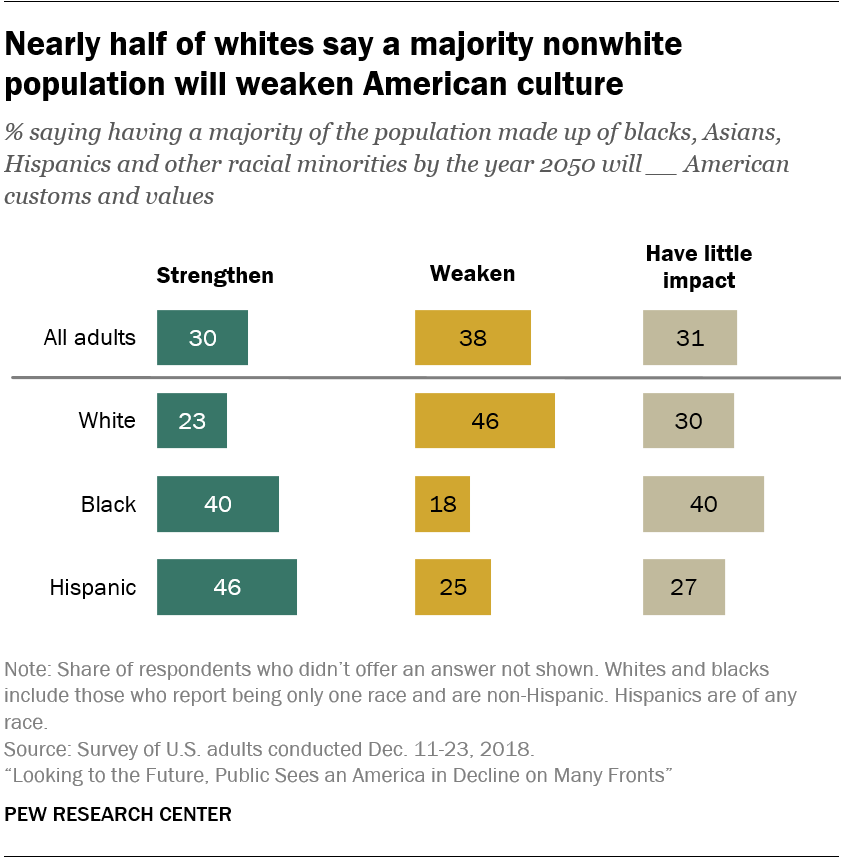 The public besides has a somewhat more positive view – or at least a more benign one – of some current demographic trends that volition shape the country's future. The U.S. Census Bureau predicts that, past 2050, blacks, Hispanics, Asians and other minorities volition constitute a bulk of the population. About four-in-10 Americans (42%) say this shift volition be neither skilful nor bad for the land while 35% believe a bulk-minority population will exist a good thing, and 23% say it will exist bad.
These views differ significantly by race and ethnicity. Whites are most twice as likely as blacks or Hispanics to view this change negatively (28% of whites vs. 13% of blacks and 12% of Hispanics). And, when asked virtually the consequences of an increasingly various America, nearly half of whites (46%) simply only a quarter of Hispanics and 18% of blacks say a majority-minority country would weaken American customs and values.
The public views another projected modify in the demographic contours of America more than ominously. By 2050, people ages 65 and older are predicted to outnumber those younger than 18, a modify that a 56% majority of all adults say will exist bad for the country.
In the confront of these problems and threats, the majority of Americans take fiddling confidence that the federal government and their elected officials are up to meeting the major challenges that prevarication ahead. More than eight-in-ten say they are worried nearly the way the government in Washington works, including 49% who are very worried. A similar share worries about the ability of political leaders to solve the nation'due south biggest problems, with 48% saying they are very worried about this. And, when asked what impact the federal regime volition have on finding solutions to the country's futurity issues, more say Washington will take a negative touch than a positive ane (55% vs. 44%).
Instead, large majorities of Americans look to science and applied science besides as to the education system to solve future issues: 87% say scientific discipline and engineering science volition have a very or somewhat positive impact in solving the nation's problems, and roughly 3-quarters say the same about public K-12 schools (77%) and colleges and universities (74%). Notwithstanding, roughly three-quarters (77%) worry about the ability of public schools to provide a quality education to tomorrow's students, and more look the quality of these schools to get worse, non ameliorate, by 2050. And just nearly a third (34%) of the state rates increased spending on scientific research as a acme policy priority.
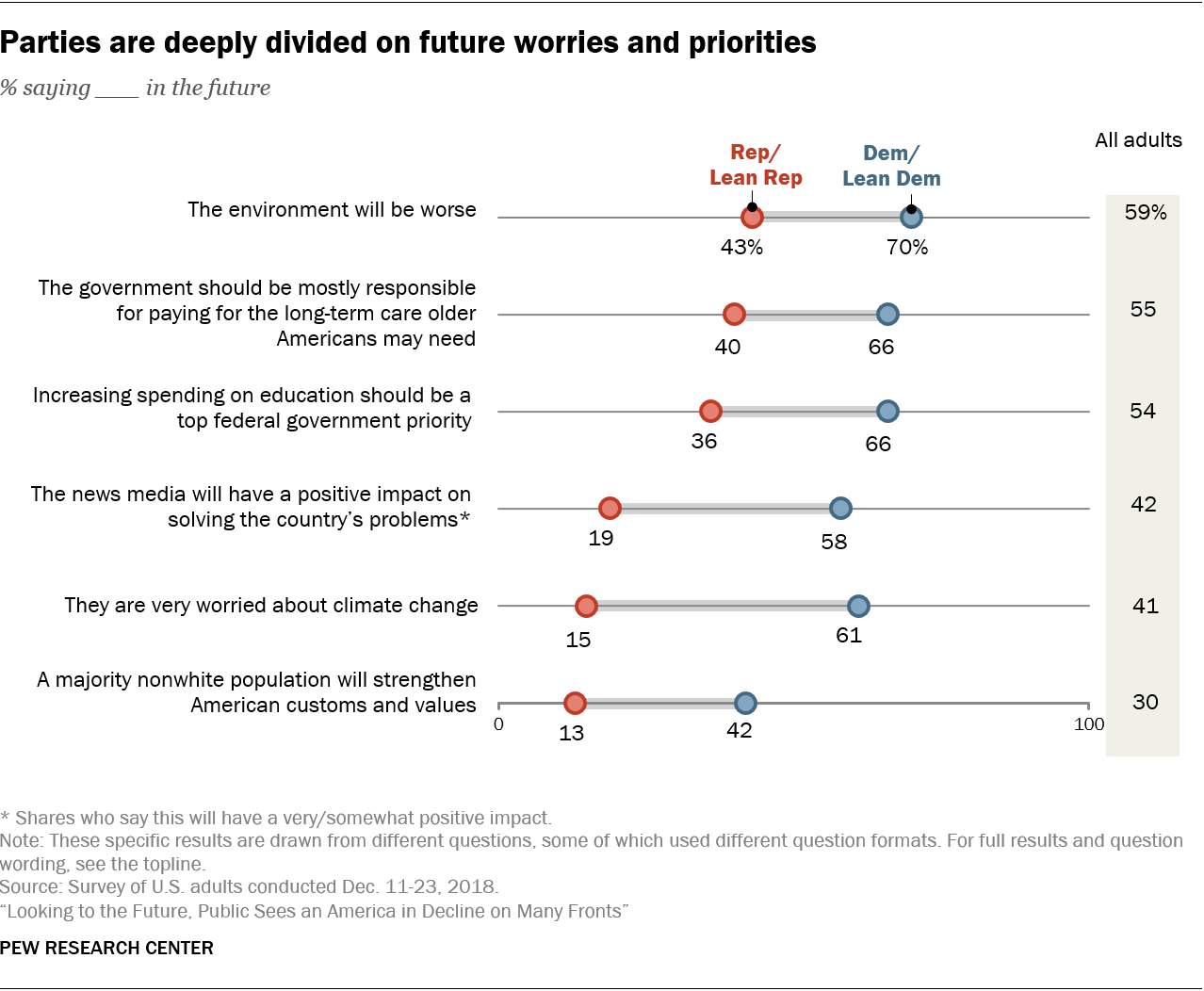
Underlying many of these and other findings are deep divisions along the traditional error lines of American life, including race, age and education. However, amid the more striking differences institute in this survey are those between Republicans and Democrats. Taken together, the size and frequency of these differences underscore the extent to which partisan polarization underpins not just the current political climate merely views of the future also.
Across a range of bug, the difference between partisans is not simply apparent, only conspicuously large. Despite shared concern about the future quality of the nation's public schools, most two-thirds of Democrats and those who lean Democratic (66%), but but 36% of Republicans and Republican leaners, rate increased spending on education as a height federal government priority. Nigh six-in-ten Democrats (58%) merely simply 19% of Republicans say the news media will have a positive impact on solving the state's hereafter problems. About 4-in-10 Democrats (42%) say a majority-nonwhite population will strengthen American customs and values, a view expressed by but 13% of Republicans. Similarly, about six-in-ten Democrats (61%) but just a third of Republicans consider the growth of interracial union to exist a good affair for lodge. Partisan gaps on future priorities reverberate similar gaps in electric current policy priorities. Recent research has shown that Republicans and Democrats accept moved farther autonomously in recent decades in their views on what the meridian priorities for Congress and the president should exist.
Partisan differences are specially large on issues related to the environs. About six-in-ten Democrats (61%) just only 15% of Republicans say they are very worried virtually climate change. An even larger share of Democrats (seventy%) predict the condition of the surroundings will go worse in the next 30 years, while 43% of Republicans concur.
Even their top priorities for the futurity are, in many instances, strikingly different. Amid all adults, wellness care and increased spending on didactics topped the list of policies that the public believes the federal government should enact to improve the quality of life for futurity generations. Notwithstanding the summit-three Republican priorities – reducing the number of undocumented immigrants, cutting the national debt and avoiding tax increases – don't fifty-fifty appear amongst the Democrats' highest v priorities.
Conversely, 3 of the five Democratic priorities – dealing with climate change, reducing the gap between rich and poor, and increasing spending on Social Security, Medicare and Medicaid – are absent-minded from the GOP's acme-five list. Providing high-quality health intendance and increasing spending on education are height priorities for each party, though larger shares of Democrats than Republicans rank these bug every bit top priorities.
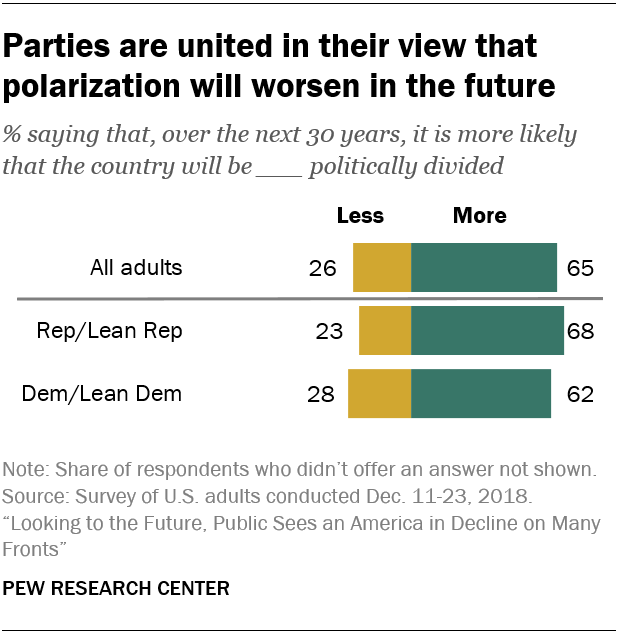 It is perhaps fitting that, while the two parties concur similar views on a number of problems, ane area of agreement stands out: Majorities of both parties hold that the country will be more politically divided in 2050 than it is today.
The nationally representative survey of two,524 adults was conducted online Dec. 11-23, 2018, using Pew Research Center'south American Trends Panel.1 Amid the other key findings:
Majorities of Americans predict a tougher time financially for older adults in 2050
Most 7-in-ten Americans (72%) look older adults volition exist less prepared financially for retirement in 2050 than they are today. An even larger share (83%) predict that about people will have to piece of work into their 70s in society to beget to retire. And the public'due south forecast for the future of the Social Security system is decidedly grim.
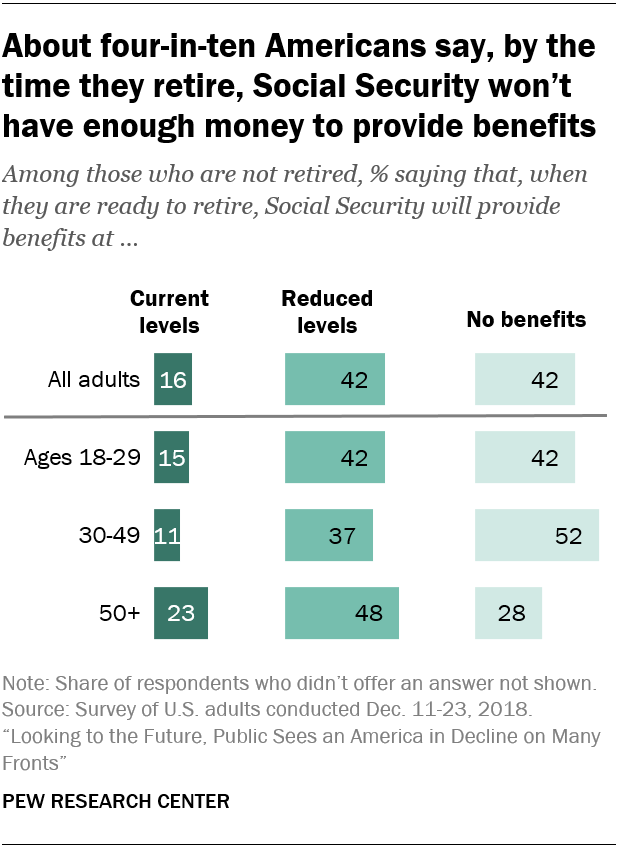 Amongst those who are not all the same retired, 42% expect to receive no Social Security benefits when they leave the workforce, and another 42% anticipate that benefits will exist reduced from what they are today.
Adults younger than 50 are particularly hundred-to-one that Social Security will be in that location when they exit the workforce: 48% expect to receive no Social Security benefits when they retire. By contrast, 28% of those who are l or older are similarly pessimistic. But fifty-fifty among this older grouping, merely most a quarter (23%) expect to receive Social Security benefits at current levels. These findings reverberate a long-standing skepticism – specially among young adults – virtually the long-term solvency of the Social Security system.
Even as they dubiety the long-term fiscal viability of the Social Security organisation, most Americans reject reducing benefits. Only a quarter believe that some reductions in benefits for future retirees will need to be fabricated to shore up the system'southward finances, while near iii times as many say benefits should not be reduced in any way.
Few Americans predict a better standard of living for families in 2050
More than four-in-ten Americans (44%) predict that the boilerplate family unit's standard of living volition get worse rather than better over the next xxx years. That's roughly double the share (20%) who wait families to fare better financially in the hereafter than they practice today; 35% predict no existent alter.
When information technology comes to prospects for children, half of the public says children volition have a worse standard of living in 30 years than they practise today, while 42% predict that they will be amend off. Men are more than likely than women to say children's standard of living will be higher in 30 years than it is today (47% vs. 36%), while those who do not accept children in the home are somewhat more pessimistic virtually this than those who do (52% vs. 44% say children volition have a worse standard of living).
Large majority says health intendance for all would do good future generations
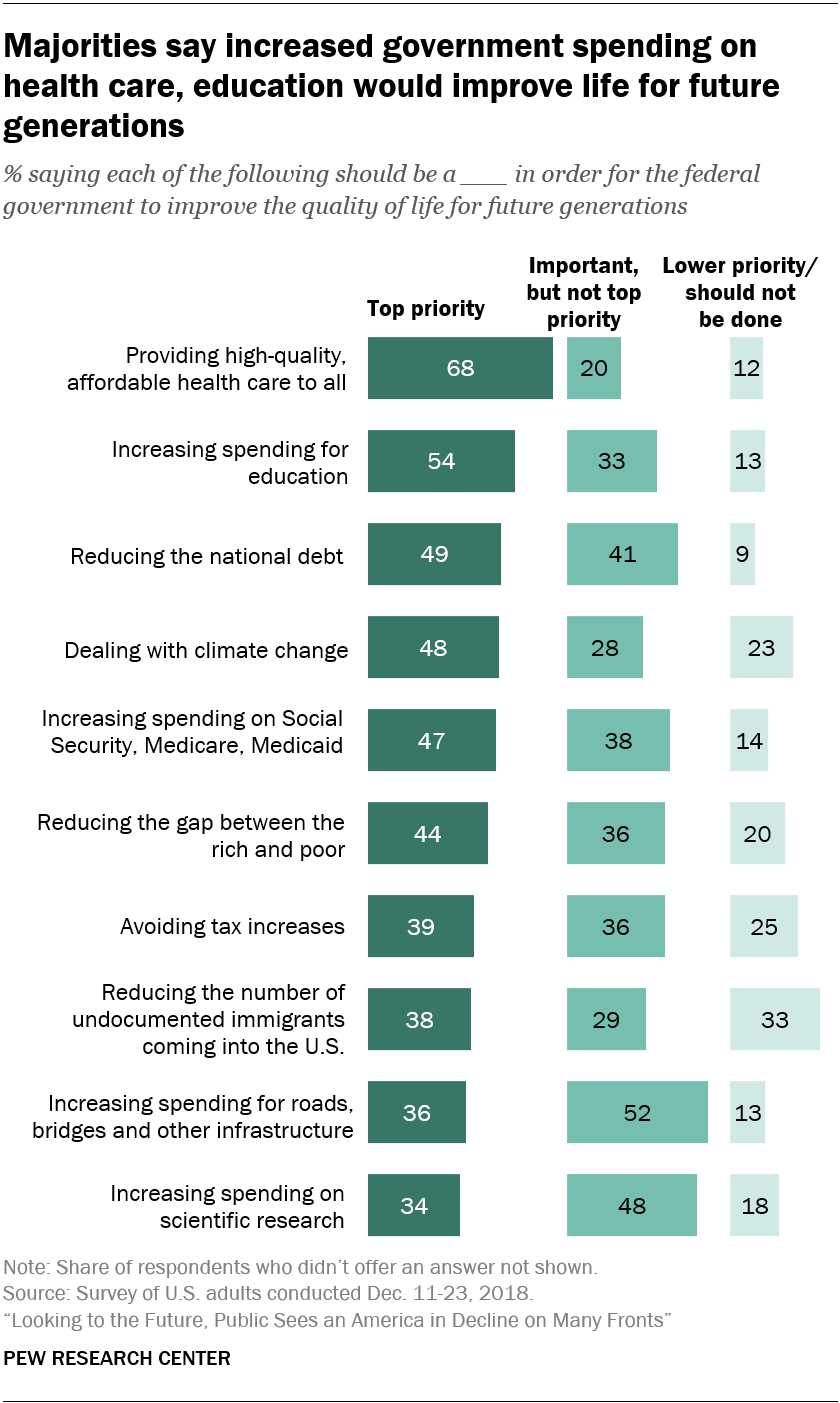 When asked what the federal government should do to improve the quality of life for future generations, providing high-quality, affordable health care to all Americans stands out as the virtually popular policy prescription. Roughly two-thirds (68%) say this should be a top priority for government in the future.
Increased spending on education is somewhat less pop; 54% say more money for schools should be a acme federal regime priority in lodge to improve life for time to come generations. Slightly fewer say the aforementioned about reducing the national debt or dealing with climate alter (49% and 48%, respectively, say each should be a elevation priority). A larger share of Republicans than Democrats prioritize cut the debt, while just the reverse is true for climatic change.
Increasing spending on Social Security, Medicare and Medicaid is viewed equally a top priority by 47% of adults, and reducing the gap betwixt rich and poor is seen as such by 44%. Falling further downwardly the list are fugitive taxation increases, reducing the number of undocumented immigrants coming into the U.S., increasing spending on infrastructure and more money for scientific research.
Minorities are more optimistic than whites about the country's hereafter
Overall, 56% of all adults say they are either very optimistic (12%) or somewhat optimistic (44%) about the U.Due south. in 2050. But more than 4-in-10 (44%) encounter the country'due south futurity more than darkly, including 13% who say they are very pessimistic and 31% who are somewhat pessimistic well-nigh America in xxx years.
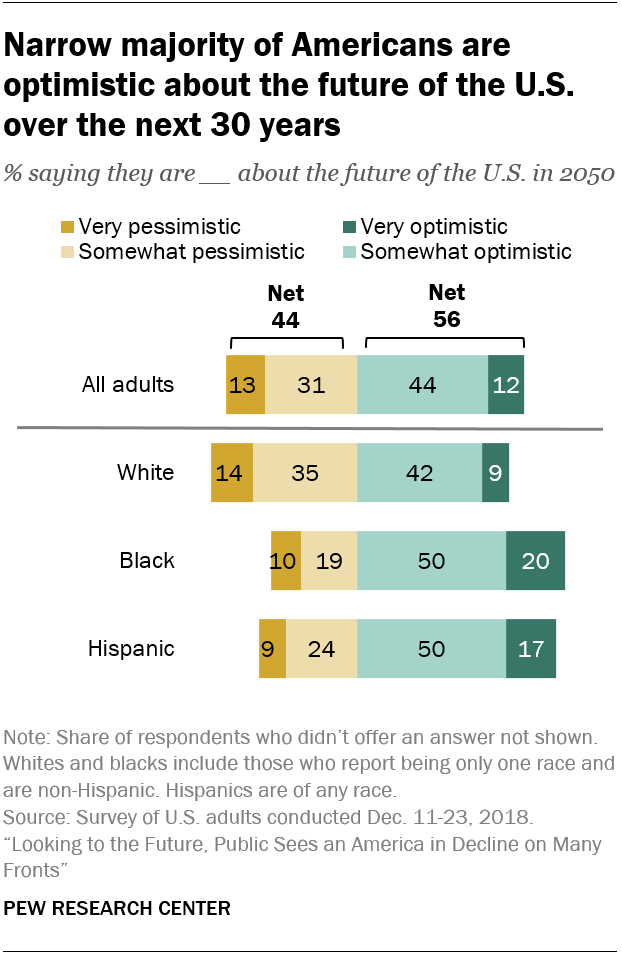 Black and Hispanic adults are among the most optimistic about the country's hereafter. Seven-in-10 blacks and two-thirds of Hispanics experience hopeful about America's futurity. In dissimilarity, about half of all whites (51%) are as confident. High school graduates and those with less education besides are somewhat more than positive about the country's prospects than are higher graduates (60% vs. 53%).
Dissimilar the wide partisan differences seen elsewhere in this survey, Democrats and Republicans are nearly equally optimistic when it comes to these broad predictions nearly America's future.
The racial design switches when Americans are asked about the future of race relations over the next 30 years. Slightly more half of all whites (54%) but 43% of blacks and 45% of Hispanics say relations volition become better. Overall, the state is divided on the future of race relations: About half (51%) say they volition amend, while 40% predict they will go worse.
Well-nigh Americans worry about the state's moral values; one-half say organized religion will become less important
Roughly four-in-ten Americans (43%) say they are very worried about the nation'southward morals, while another 34% are fairly worried. For Republicans, the country's moral health is a major business organisation: Roughly half (49%) say, when they think about the country's futurity, they are very worried about the moral values of Americans. But about a third of Democrats (36%) are equally worried. Women are more concerned about the country's morals than men (46% vs. 38%), while older Americans are more worried than those younger than 50 (49% vs. 37%).
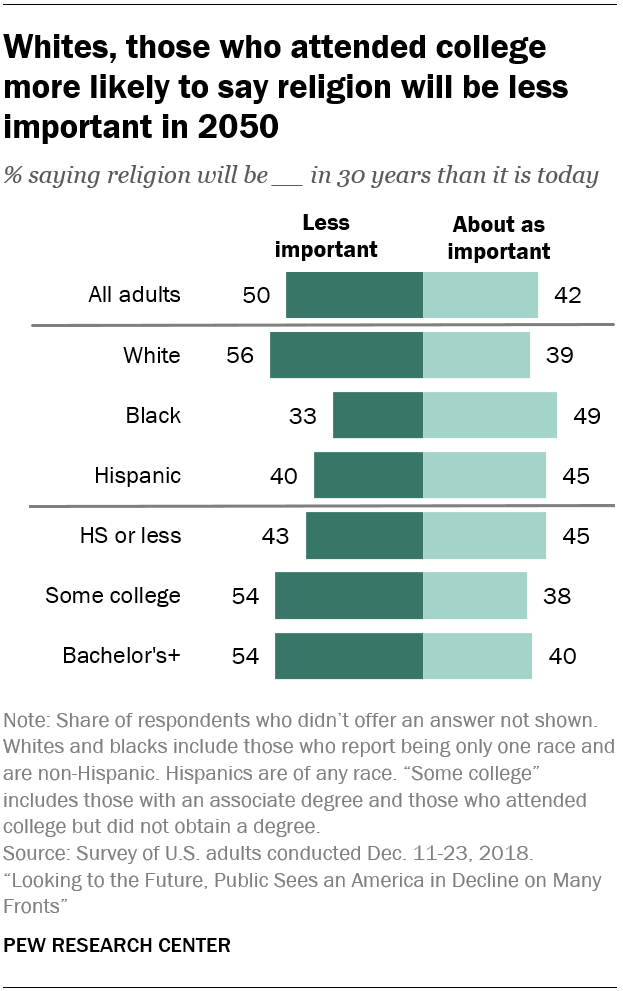 The public is divided over whether faith volition get less important over the next thirty years than it is now. Half say organized religion volition lose importance, while 42% say information technology will remain unchanged (respondents were non given the option of saying organized religion will exist more than of import).
A majority of whites (56%) but only a third of blacks and four-in-ten Hispanics say the importance of faith will decline over the next 30 years. Adults with more formal education are more than likely to meet faith in eclipse than those with less: 54% of all college graduates but 43% of those with a high school caste or less education predict the declining importance of religion.
Amidst religious groups, roughly equal shares of white evangelicals (52%), white mainline Protestants (51%) and white Catholics (54%) say religion volition be less important in the futurity – a view held by a similar share (59%) of those who are atheist, agnostic or zero in particular.
Older adults, those with less teaching more than negative almost the impact of automation
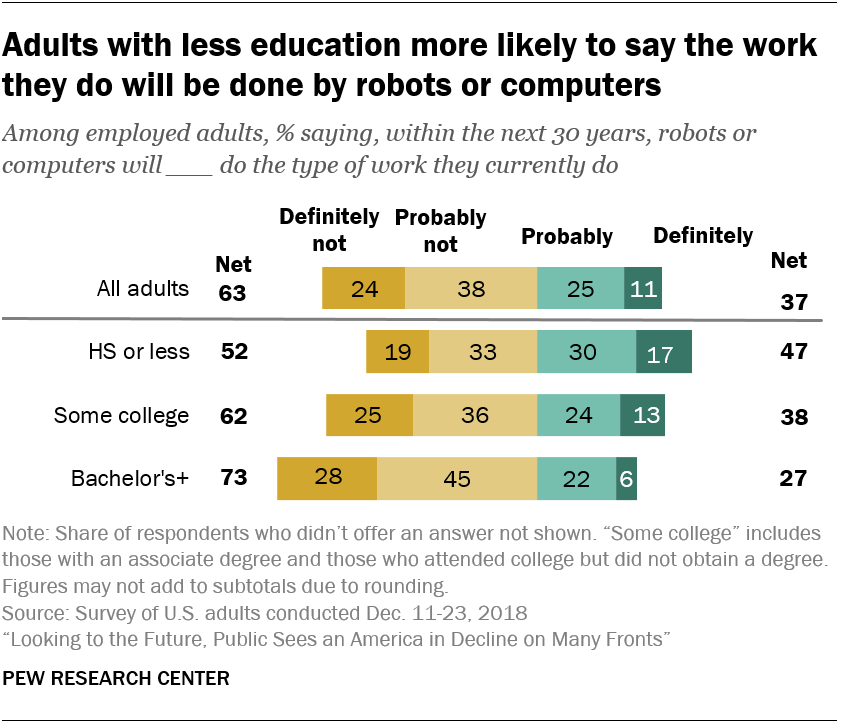 While only 37% of all currently employed Americans personally encounter automation equally a direct threat to their current occupation, less well-educated workers are likelier than those with more than formal schooling to say the blazon of work they do will be done by robots or computers in the future. Nearly one-half (47%) of those with a high schoolhouse diploma or less education say this change volition occur compared with 38% of those with some college experience and 27% of those with a bachelor's or advanced degree.
Almost Americans agree that the workplaces of the future will be heavily automated. Almost 8-in-ten (82%) predict that robots and computers will do much of the work currently washed by humans – a possibility that many adults with less education view with suspicion, if not outright dread. Among those who say robots and computers will do much of the piece of work currently done by humans, about eight-in-10 of those with a high school diploma or less education say this would be a bad affair for the country (39% say it would be very bad; 39% say it would be somewhat bad). Those with a bachelor's caste or more educational activity are less fearful: Roughly 6-in-10 say an automated workplace would exist very (13%) or somewhat bad (45%).
Regardless of educational background, most Americans predict that automation in the workplace will increase inequality betwixt the rich and the poor and will not issue in new, better-paying jobs.
Who will pay – and who should pay – for long-term eldercare in the future?
A slim bulk of Americans (55%) say that government should be mostly responsible for paying for long-term intendance for older adults who need help in the future. But when asked who will be responsible for paying for this care in the future, only about half that share (28%) say the financial brunt will autumn on the government. Instead, about 7-in-ten predict that family unit members (35%) or older adults themselves (36%) will bear these costs.
Like shares of virtually cardinal demographic groups agree most who will pay the bills for long-term care in the future. But these groups frequently differ about who should be primarily responsible for the costs of this care. Two-thirds of blacks and Hispanics (67%) say authorities should be mostly responsible for paying for long-term care for older adults, while well-nigh one-half of whites (51%) agree. Similarly, two-thirds of adults ages 50 to 64 say authorities should exist mostly responsible for this care compared with about half of all other age groups, including those 65 and older. In improver, two-thirds of Americans with family incomes under $xxx,000 await to government to cover the cost, compared with about one-half of those with higher incomes.
Democrats see a bigger function than Republicans for the authorities in paying for long-term elder care (66% vs. 40%). On the other hand, Republicans are about twice every bit probable every bit Democrats to believe older adults themselves should exist primarily responsible for paying for their care (xl% vs. 21%). Relatively few Democrats (11%) or Republicans (eighteen%) say the responsibleness should fall mainly to family members.
Predictions about the future of marriage, divorce and childbearing differ by race
Overall, virtually one-half of adults (53%) say that, by 2050, people volition be less probable to get married than they are today. Very few (seven%) predict that people will be more likely to marry in the hereafter, and 39% say things will stay about the same. Whites and Hispanics are much more than likely than blacks to predict lower marriage rates in the time to come – 56% of whites and 53% of Hispanics say people will be less likely to ally compared with 34% of blacks. Blacks are the only group in which a majority say marriage rates will stay the same or increase. According to the U.S. Census Agency, blacks are significantly less likely than whites or Hispanics to be married. Amongst those ages 18 and older, 31% of blacks were married in 2022 compared with 46% of Hispanics and 54% of whites.2
Predictions about the future of divorce reveal a somewhat different design. More than six-in-x whites (64%) but half of blacks and 42% of Hispanics expect people volition be about as likely to become divorced in 2050 every bit they are today. In this regard, Hispanics are more pessimistic than whites about the future country of marriage: 37% predict that people volition be more than probable to divorce in the futurity, compared with 27% of whites and 30% of blacks.
More than four-in-x Americans (46%) expect that, by 2050, people will exist less likely to accept children than they are now. A similar share (43%) call back people volition exist virtually equally probable to have children, while just one-in-ten expect people to be more than likely to have children in the futurity. Young adults are more than probable than older Americans to say this is the case. Even so, but 18% of those ages 18 to 29 say they look that people in 2050 will exist more likely to have children, compared with 9% of adults 30 to 49 and 7% of those ages fifty and older.
Source: https://www.pewresearch.org/social-trends/2019/03/21/public-sees-an-america-in-decline-on-many-fronts/

Posting Komentar untuk "Looking Ahead Twenty Years in the United States, We Can Predict With Confidence That"